Intermittent City: Developing Micro-Laboratories of Coexistence in the Age of Adaptation
A. Allegri & R. Ochoa
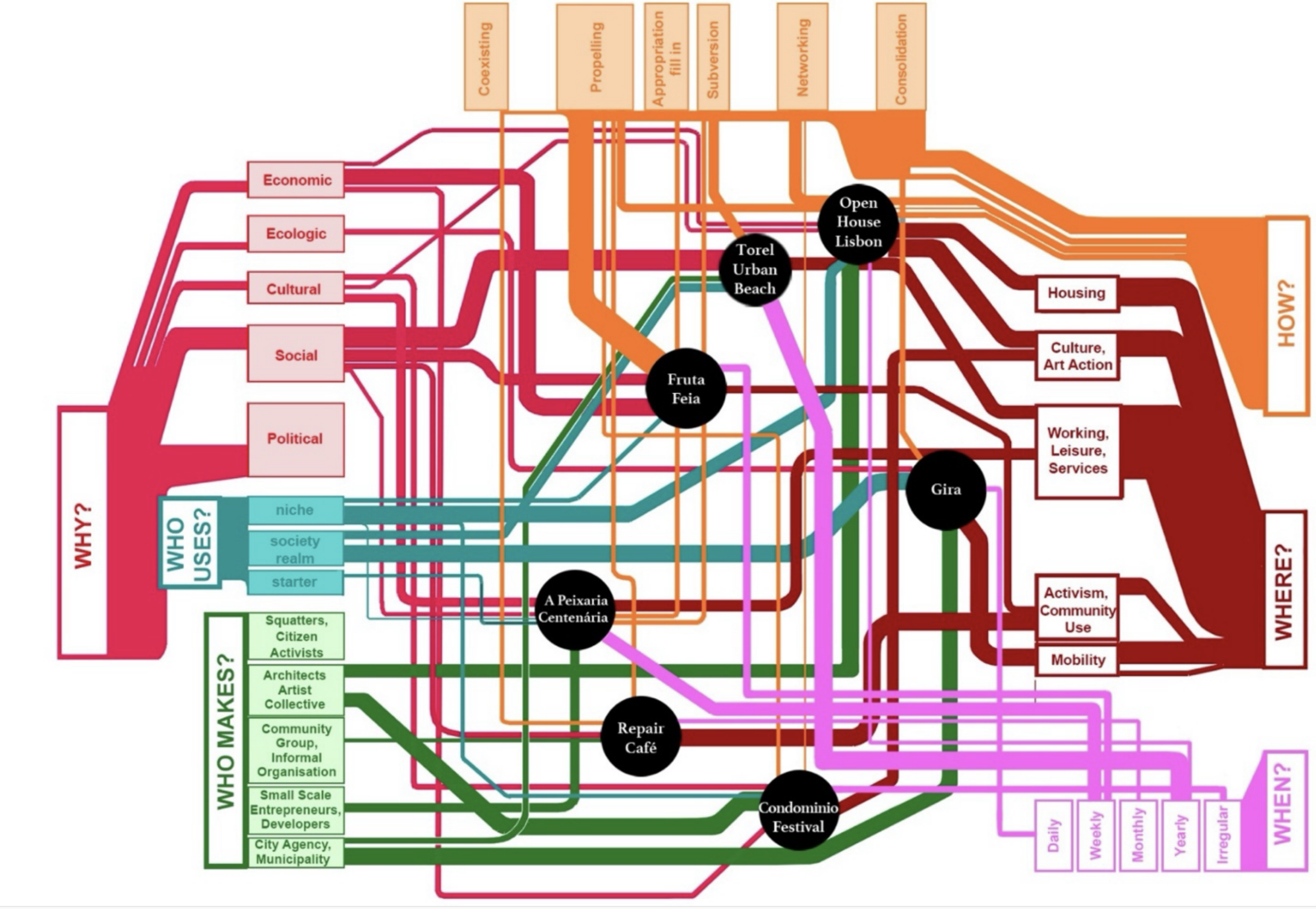
Intermittent City is a Lisbon-based research and action platform developed by a multidisciplinary team, aligned with the core themes of WG3. After three years of activity, it aims to develop and scale up the concept of micro-laboratories of coexistence: intermittent urban installations that help cities adapt to environmental, social, and technological transitions—especially in contexts of climate crisis, social instability, and spatial inequality.
Positioned between permanence and ephemerality, crisis and regeneration, these laboratories will operate through four interconnected axes:
(i) Plural Intelligence: combining natural (ecosystems), artificial (digital tools), and collective (community) knowledge in design processes;
(ii) Distributed Authorship and Transdisciplinary Collaboration: designers act as facilitators within non-hierarchical networks involving architects, scientists, artists, citizens, and activists, co-creating situated responses;
(iii) Circular Strategies: each laboratory acts as a seed for an adaptive urban ecosystem, promoting cycles of material and social regeneration;
(iv) Relational Structures: these spaces foster inclusion, openness, and coexistence in uncertain times, serving as platforms for experimentation and intergenerational learning.
By exploring intersecting paths with the COST Action, the proposed presentation aims to contribute to both theoretical and practical agendas by offering transferable methodologies and light governance tools that address climate and social urgency. It suggests a model that bridges local experimentation and broader European collaboration—not merely by documenting practices, but by introducing adaptable formats and co-design strategies. Finally, it seeks to frame adaptive urbanism as both a critical pedagogy and a design tool in the age of adaptation.