Skopje Urban Stories: Site-Specific Artistic Practices
Prof. Slavica Janešlieva, PhD, MFA
Ss. Cyril and Methodius University in Skopje, North Macedonia
This presentation explores site-specific artistic interventions in public space in Skopje over the past two decades, focusing on artistic practices that address mobility, urban heritage, participation, sustainability and circularity within a city shaped by continuous political and symbolic transformation. From socialist Yugoslavia to the contemporary context of North Macedonia, Skopje represents a dynamic urban environment where questions of belonging, memory and the right to the city are constantly renegotiated.
Drawing on the recent project Skopje, Sensory City (2025, curated by Ana Frangovska), the presentation foregrounds non-institutional and participatory artistic practices that activate public space through embodied, sensory, and performative strategies. Early initiatives such as Redefining Public Spaces (2007) (NGO Kontrapunkt & Točka) demonstrate artistic mobility and knowledge exchange operating beyond institutional frameworks. Gjorgje Jovanovik’s Whistling Buildings addresses civic disengagement and the deterioration of shared urban responsibility, while Slavica Janešlieva’s Philanthropic Urges critically reflects on cultural sustainability and circular use of existing urban structures through the fictive reactivation of the former NaMA department store as a Collection of Contemporary Art.
Further examples include Igor Sekovski’s Visionary (2009), which anticipates the consequences of monument-driven urban policies; Aleksandar Spasoski’s sound intervention The Ship That Never Passed (2012), read as a metaphor for prolonged socio-political transition and restricted mobility; and later works by Dijana Tomić, Monika Moteska and Robert Jankuloski, Goce Nanevski, Svetlana Volić and others, which explore embodied memory, informal heritage, urban decay and resistance.
Collectively, these practices demonstrate how site-specific artistic interventions in Skopje function as tools for participatory engagement, sustainable reuse of urban space, and circular cultural production, offering alternative models for understanding heritage, collective consciousness and the role of art in shaping inclusive urban futures.
Image 1: Igor Sekovski, Visionary (Kim Il Sung), 2009, digital collage & print, 1.7 × 3 m (all rights reserved by Sekovski). In the background, the main square in Skopje, North Macedonia. (photo: Igor Sekovski)
Revival of Historical Buildings through Art: The Case of Prizrenn
Medina Çeko
AAB College, Faculty of Architecture, Prishtina, Kosova
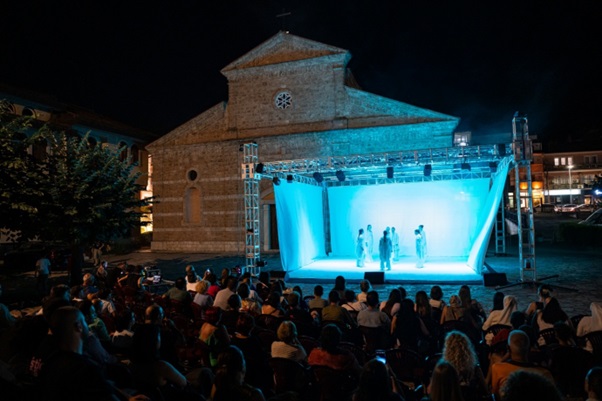
Prizren, as one of the cities richest in cultural heritage in Kosovo, represents a distinctive case for examining the revival of historical buildings through art and the impact of this approach on urban tourism. This paper explores how artistic interventions, cultural festivals, and the creative use of heritage spaces have contributed to the revitalization of historic buildings and to the increased tourist attractiveness of the city. Initiatives such as film, theater, and contemporary art festivals organized within historic structures have created a new relationship between heritage and contemporary cultural practices, transforming the city into a “living museum.” Through these activities, historical buildings no longer remain static monuments but become active social and economic spaces. The study highlights that art not only supports the preservation and maintenance of heritage but also directly influences the development of cultural tourism, the growth in visitor numbers, and the strengthening of local identity. However, the paper also emphasizes the need for these processes to be inclusive and accessible to all social groups, in order to ensure that cultural and tourism development remains sustainable and equitable. This paper contributes to the debate on urban regeneration through art by providing a contextual analysis of Prizren as a model of combining historical heritage with contemporary cultural practices.
Image 2: A scene from Prizrenfest, an international open-air theatre festival in Prizren, Kosovo. Photo by Esad Duraki ( Open Air International Theatre Festival in Prizren / Kosovo).
From art interventions to communal rituals: Site-specific Urban Practices for Cocreation, Theorizing, Care
Hanna Musiol, PhD
Norwegian University of Science and Technology, Norway
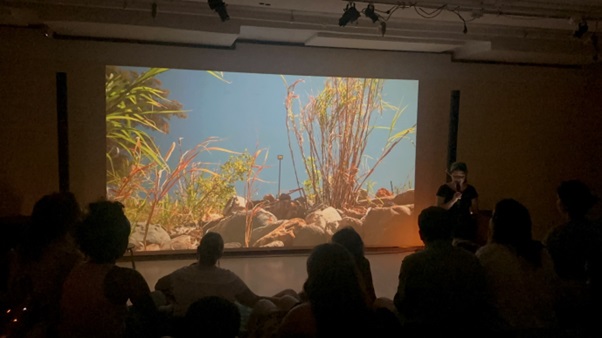
CICULARTs aims to promote new methods, pedagogies, inclusive arts, and (as) barometers or “vital signs” of urban sustainability and “survivance,” and this talk addresses the two working groups’ combined interest in artistic urban practice and theory (Varghese; Vizenor). Specifically, they foreground pluriversal theories and artistic practice as foundations of more inclusive urban art design (Partham) and as pedagogical models for urban actions devoted to equity and cocreation (Grandoit-Šutka; Lambert). This talk moves away from a view of urban theory as mostly Western, white, masculinists, and written in majority languages toward a critical pedagogy pluriversal approach in which inclusive theory and art practice are inseparable, and are generated and rehearsed collectively with diverse communities, via different media and arts, in conversation and conflict with dominant epistemologies. This talk also addresses a major challenge of this approach: the archives of urban art interventions are ephemeral, the theories we rely on are as exclusionary as our cities, and the Transforming individual art interventions into community ritual poses major challenges. How can we promote different, sustainable, and communal kinds of urban thinking, learning, and gathering?
Drawing from the work of Theaster Gates, AbdouMaliq Simone, Elina Alatalo, Sara Zewde, Laura Kern, Klaske Havik, Eliane Brum, and other radical urban thinkers and art practitioners, this talk focuses on recent examples of art-based urban space-making initiatives that bring together local and transient, Indigenous, queer, dis-abled, Afropean, immigrant, senior thinker-residents (in solidarity ceremonies led by Mapuche and Sami artivists in Trondheim; Søstrene Suse’s Radiokino decolonial listening zones; WIMBLU’s transmedia ecological seances, walkshops and counter-cartographies across Europe, and more). It will conclude with a reflection about how our COST Action could recognize such nonacademic work and epistemologies as tools and pedagogies for non-necrotic urban futuring that “de-segregate” space, artistic practice, and thought (Thiong’o; Brim; Maki; Khosravi); draw ethically from participatory and utopian urban theorizing (inclusive public recitations, listening sessions, speculative street theatre, mixmedia installations, etc.) as a method for organizing, thinking, and building (Dominique Hétu et al., Rault and Cowan; Khan); and promote urban bio(cultural)diversity space-making and sharing practices via the COST activities.
Image 3: An Afternoon of Living Stories: a transmedia ecological storytelling performance led WIMBLU’s Carolina May and Alessandra Baltadano. Co-organized with Trondheim Kunsthall, Narrating Sustainability, and Just Pedagogies, NTNU. Photo by Jan T.H. Ennker
Kunsthall Trondheim, Trondheim, Norway.
“Dreaming of water” A ch’ixi practices by Ceclia Vucuña
Katarzyna Cytlak, PhD
University of Torun, Poland
This text examines Cecilia Vicuña’s retrospective exhibition Dreaming of Water. A Retrospective of the Future (1964–…) at the Pinacoteca de São Paulo (2024) through the conceptual framework of ch’ixi developed by Bolivian thinker Silvia Rivera Cusicanqui. The ch’ixi concept—understood as a non-dialectical coexistence of difference that resists linear temporality and Eurocentric logic—serves as a key lens for interpreting Vicuña’s artistic practice. The exhibition presents Vicuña’s multidisciplinary work as a form of poetic, ecological, feminist, and political activism that consistently challenges Western artistic canons and colonial epistemologies. Through painting, visual poetry, video art, performance, and installation, Vicuña articulates an Andean cosmology grounded in cyclicality, care for nature, and collective responsibility.
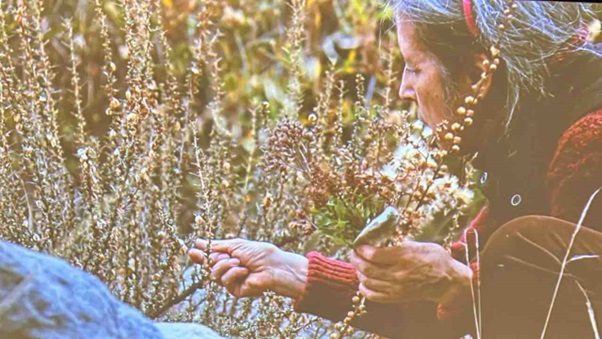
Particular attention is given to works such as Semiya / Seed Song (2015), Paracas (1983), Palabrarmas (from 1966 onward), and Quipu menstrual (the blood of glaciers) (2006), which foreground themes of extinction, ecological violence, feminist ritual, and resistance to authoritarian power. Vicuña’s use of seeds, textiles, bodily gestures, and communal actions redefines artistic practice as an embodied, relational, and decolonizing process. Her work resonates with Rivera Cusicanqui’s call for an Andean iconography independent of European visual regimes and proposes art as a tangible means of imagining alternative modes of coexistence. Ultimately, the exhibition positions Vicuña’s practice as a lived enactment of a ch’ixi world—one in which ecological, social, and cultural tensions are not resolved but held together in a productive and ethical balance.
Image 4: Vicuña, Cecilia, Semiya / Seed Song (2015), video, color, 7’45’’, camera and editing Christan Chierego, Collection Cecilia Vicuña.