Insert Country
Insert Dates
2nd Station
General Presentation
Documentation Events
Scientific Production
TRAINING SCHOOL OUTPUT
Artistic Manifestations
Program Lectures & Training Schools
Program Artistic Manifestations
XCIRCUL’ARTS

COST CIRCUL’ARTs Working Group Meetings & Training School
“The Gesture That Remains: Crafts of São Miguel”
Introduction
CIRCUL’ARTS
Artistic Practices, Critical Pedagogies and Ecological Thinking
Conference,Training School and Photography Exhibition
The European Cost project CIRCUL'ARTs is dedicated to contemporary artistic and creative practices in the fields of urban circularity and critical and innovative pedagogies. Circularity is understood as practices of sharing not only material resources, but historical knowledge, vernacular solutions, solidarity practices, the transmission of memories and know-how. This international and interdisciplinary project involving around 300 members and which is set over 4 years (2024-2028) is based on reciprocal knowledge construction with scholars, artists and other cultural practitioners.
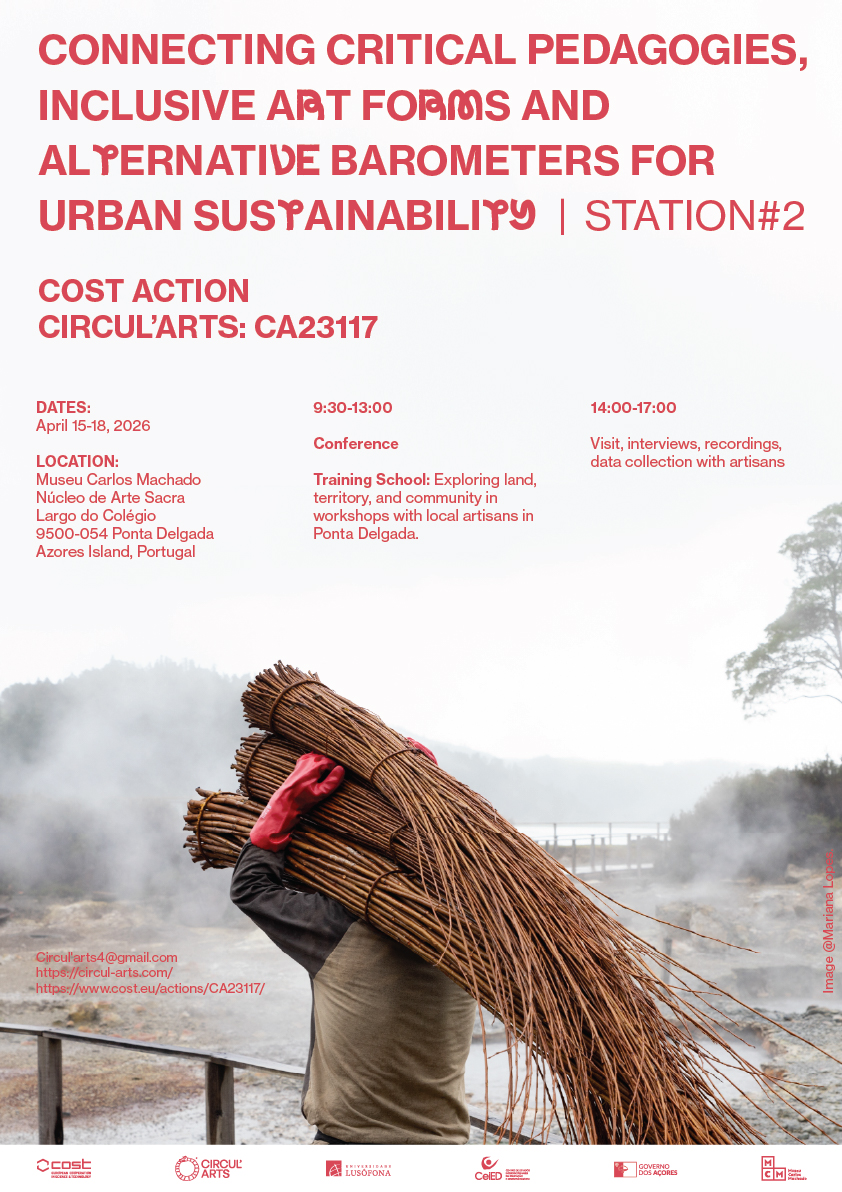
Station#2 will take place from 15 to 18 April 2026 at the Museu Carlos Machado in Ponta Delgada, Azores (Portugal).
The location was chosen because it offers a wide range of local and ancestral material and immaterial circular practices that remain economically sustainable today, making it a unique context in Europe.
The program consist of a conference and a Training School with local craft ateliers and an exhibition of Azorean photographer Mariana Lopes, focused on the material presence, the design and the circulation of the objects produced by the local ateliers.
15th-18th of April, 2026
Conference and Training Schools, MuseuCarlos Machado in Ponta Delgada, Azores (Portugal).
16thof April, 6 pm
Opening Solo Exhibition Mariana Lopes MuseuCarlos Machado in Ponta Delgada, Azores (Portugal).
About Documentation Events
PRESS REVIEWS
2nd Station - Conference photo documentation
2nd Station - Training School photo documentation
About Scientific Production
Coming Soon
2nd Station Final Program
Presentations` Station#2 - WG 02 "Urban rituals, performances, street theatre, music"
Leader & co-leaders: Slavica Janešlieva, Hanna Musiol, Katarzyna Cytlak
Presentations` Station#2 - WG 03 "Urban installations and gathering points"
Leader & co-leaders: Dr Agata Piet,
Dr Isabel Carvalho
Presentations` Station#2 - WG 06 "Dissemination and recommendations"
Leader: Rahmin Bender-Salazar
About Grant Output
Coming Soon
Coming Soon
-
About Program Lectures & Training Schools
Coming Soon
COST CIRCUL’ARTs Working Group Meetings & Training School
Location: Museu Carlos Machado, Ponte Delgada, Azores
Inspiring Circular Futures: Territory, Knowledges, and Community
Guiding Question:
How can we envision a circular economy that respects local territories, decentralizes knowledge, and empowers communities?
DATES: April 15-18 , Azores – Portugal
LOCATION: Museu Carlos Machado
Núcleo de Arte Sacra
Largo do Colégio
9500-054 Ponta Delgada
TRAVEL INFORMATION: Travel trips to artisan's ateliers are organized by bus for us by the Museum
Day 1, 2, 3:
9:30-13:00 > Conference at Museu Carlos Machado, Ponte Delgada, Azores
>Training School: Exploring Land, Territory, and Community in Workshops with different local artisans in Ponte Delgada.
14:00-17:00 > Visit, interviews, recordings, data collection with Artisans (Conference Members and Trainees)
Day 1
A. Conference
9.30-10-00: Welcome coffee and Introductions
WG 1
10:00 – 10:10 > “Revisiting the Role of Critical Pedagogies in Contemporary Contexts: Insights from Circularts Research and Practice” an introduction to WG1 overall developments 2nd COST year – Carla Inguaggiato, Paolo Do
10:10 – 11:00 > Case Study Presentations – WG1 (5 × 10 min)
10:10 – 10:20 > “SomaGaia: An Embodied Ecological Framework for Dance Pedagogy Evidence from an Art and Movement Workshop with children and the Dance-Drama “The Nine Muses” - Evgenia Gratsouna
10:20 – 10:30 > “Emancipatory transformations towards agroecology: cases in Switzerland” - Johanna Jacobi
10:30 – 10:40 > “The Role of Critical Pedagogies and Applied Arts in Fostering More Just and Pluralistic Classrooms” - Analía Capponi-Savolainen
10:40 – 10:50 > “Flood Embassy: Situated, Imaginative and Performative Learning through the River” - Kitti Baracsi
10:50 – 11:00 > “Radical Care Through Artistic and Intercultural Practices: Transformative Grassroots Pedagogies for Inclusive Sustainability in Tampere, Finland” - Turkan Firinci Orman
11:00 – 11:10 > Coffee Break
WG2
11:10 – 11:20 > Introduction to WG 2 overall developments 2nd Cost year: Slavica Janešlieva (leader) & Katarzyna Cytlak (co-leader)
11:20 – 12:10 > Case Study Presentations – WG2 (5 presentations × 10 min each)
1."Salas-fantasma: an artistic investigation into the early 20th century cinema theatres in Lisbon" - project by Amadea Kovič & Eduardo Prado Cardoso, YR WG2 of trainee at Azores Station & presenter Amadea Kovič
2."Contemporary Carnival as a Participatory Urban Ritual: the Case of the Fluxus Festival in Kaunas", Rūta Mažeikienė
3."Acoustic phonon drag in metals", Burak Bal
4."Mediated texts and the sensitization of public perception on migration", Mirela Imširović
5."Chasing the Invisiblized Heritage. Contemporary Photographers in search of Afro-Argentinian Identities.", Katarzyna Cytlak
12:10 – 13:00 > Q&A and Discussion (WG1 & WG2)
13:00 – 14:00 > Lunch Break
B. Training School DAY 1.
9:00 – 10:00 > Travel to the northeastern part of the island
10:00 – 12:00 > Trainees in Workshop at Casa de Trabalho do Nordeste
12:00 – 13:00 >Going back to Ponta Delgada
13:00 – 14:00 > Lunch Break
Conference and Training School Members DAY 1.
14:00 – 17:00 > Participants are divided in 2 groups:
1) Group 1: visit ARRISCA (https://arrisca.pt/)
2) Group 2: visit Artisans working with Fish scales ( https://artesanato.azores.gov.pt/catalogodigital/pt/escama-de-peixe
Day 2
A. Conference
WG5
9:30 – 9.35> Introduction to WG 5 overall developments 2nd Cost year - A. Mota & G. Tusa
9:35 – 10:30 > Case Study Presentations – WG5 (6 presentations × 8 min each)
• ‘Woven Ecologies: Textile Art, Ancestral Knowledge, and Circular Futures in North Africa’ - Amine Haj Taieb
• ‘Circular Economy and Biocultural Heritage in Shaping Sustainable Island Livestock Systems’ - Nurinisa Esenbuga
• ‘Regenerative Mourning, Territory and Circularity in Eliana Otta’s Hybrid Art’ - Carla Almanza-Gálvez
• ‘Beda Yatra - traditional boat journeys , a case study for Circul’art WG5’ - Sunny Sandhu
• ‘Civic Engagement and Perceived Social Resilience in Urban Neighbourhoods: Cross-Country Evidence from the UPRUN Project’ - Lina Seduikyte
• ‘Revitalizing Nature through Visual Storytelling: Documenting the Ecological Crisis of Dried Lakes in Turkey’ - Onur Birol
WG3
10:30 – 10:38 > Agata Pięt: “Interfering Urbanisms: Art, Temporality, Inclusion, and Decolonial Pathways Toward Circular Futures” Introduction to WG 3 overall developments 2nd Cost year.
10:38 – 10:46 > Isabel Carvalho: “Collective Memory in Urban Spaces: Reclaiming Women’s Representation through Augmented Reality”
10:46 – 10:54> Matej Nikšič: “Reviving Ancestral Landscapes through Circular Placemaking and Artistic Intervention in Polhograjski Dolomiti Landscape Park, Slovenia, and Pretoria localities, South Africa”
10:54 – 11:02 > Clara Sarmento: “Decolonial Art Practices for Circular Futures: Lessons from the Moliceiro Cultural Ecosystem”
11:02 – 11:10> Inti Bertocchi: “Rethinking Institutions in the Era of Polycrisis to Achieve an Integral Local Development”
11:10 – 11:18 > Yelena Pozdnyakova: “Between Art, Economy, and Care: A Case Study of Intergenerational Skill-Sharing and Circular Economy”
11:18 – 11:30: coffee break
WG4
11:30 – 11:35: Introduction to WG 4 overall developments 2nd Cost year, Gerald Leindecker (LEADER PRESENTING THE WG)
11:35 – 12:15: Case Study Presentations – WG 4 (5 presentations × 8 min each)
• 1. Aleksandra Djukic: Creative Innovative Methodologies in Teaching and Practicing Urban Design: Building Camp as a Result of Interdisciplinary Approach, Circularity and Participation
• 2. Aleksandra Stupar: OVERCOMING URBAN FEARS VIA CIRCULAR PRACTICES
• 3. C. Lambis Baniotopoulos: Upcycling of Wind Turbine Blades to Modern Structures and Infrastructure in the Third World.
• 4. Renee Wansdronk: Zero emission building concept: The building concept knowledge development, and its dissemination and implementation
• 5. Onur Birol: Digital Twin Technology for Circular Heritage Restoration: Kremna Propylon
•
12:15 – 13:00 > Q&A and Discussion (WG3 & WG4 &WG5)
13:00 – 14:00 > Lunch Break
B. Training School DAY 2.
10:00 – 12:00 > Trainees in Workshop at Cerâmica Vieira (Lagoa)
(https://juntarosario.org/turismo/patrimonio-cultura-e-ciencia/ceramica-vieira/)
12:00 – 12:30 > Return to Ponta Delgada
12:30 – 13:30 > Lunch Break
Conference and Training School Members DAY 2.
13:45 – 14:30 > Travel to Gorreana
14:30 – 17:00 > Visit at the GORREANA TEA Factory
Day 3
A. Conference
WG6
10:00 – 10:10 > “Creating Bridges in the Transdisciplinary Work of Circul’arts through Systems Thinking, Co-creation, and Learning” an introduction to WG6 overall developments 2nd COST year - Breanne Pitt, Christian Roth, and Rahmin Bender-Salazar
10:10 – 11:00 > Case Study Presentations – WG6 (5 × 10 min)
10:10 – 10:20 > “It’s All About the Vibes: Embedding Creativity and the Arts in Circularity” - Gilberto Morishaw
10:20 – 10:30 > “Contested Circularities: A Collaborative Digital Exhibition on Socio-Technical Systems” - Freyja van den Boom
10:30 – 10:40 > “Workshop Design for Disseminating Working Group Outcomes in Circular City Contexts: A Rapid Prototyping Approach” an interactive session - Banu Yücel Toy
10:40 – 10:50 > “Creating Resonance with Audiences: Igniting sparks of Curiosity in Research and Practice” - Christian Roth
10:50 – 11:00 > “Creative workshops for systemic risk literacy: An open pedagogical methodology for dissemination” - Jonathan Millie
11:00 – 11:20 > Q&A and Discussion
11:20 – 11:30 > Coffee Break
11:30 – 12:30 > Round-table - How can artistic gestures embody circular abundance5? With Mariana Lopes (RARA and Walk &Talk) e Joana Dias (Centro de Artesanato e Design dos Açores)
12:30 – 13:00 > Q&A and Discussion
13:00 – 14:00 > Lunch Break
B. Training School DAY 3.
10:00 – 12:00 > Trainees in Workshop at MUSA AZORES (Vanessa Melo)
12:30 – 13:30 > Lunch Break
Conference and Training School Members
Participants are divided in 2 groups:
Group 1:
13:45 – 14:30 > Travel to Água de Pau
14:30 – 16:00 > Wicker workshop of Alcídio Andrade DAY 3.
(https://www.facebook.com/acores.hoje/videos/artesanato-vimes/647252147591502/)
Group 2:
13:45 – 14:30 > Travel to Vila Franca do Campo
14:30 – 16:00 > Handicraft and Social Solidarity Cooperative Senhora da Paz DAY 3.
(https://www.facebook.com/CooperativaArtesanatoSra.daPaz/)
Group 1 +2:
16:00 – 16:30 > Visit to the Furnas (https://www.saomiguelguide.com/en/furnas)
16:30 – 19:30 > Visit to Furnas Lagoon to see the activity of removing the pots from the holes where the stew is prepared; visit to the Furnas Calderas watching the cooking of corn and wicker (and talk to those who carry out this work).
19:30 > Joint Dinner (MC + WG + TS) – traditional dinner with local gastronomy.
Day 4
10:00 – 12:30 Management Committee Meeting
12:30 – 14:00 Lunch Break
14:00 – 16:30 Core Group Meeting
16:30 Departure – Home Sweet Home!
OVERVIEW ARTISANS WORKSHOPS
DAY 1:
1. Casa do Trabalho Nordeste (founded 1954) is one of the most genuine examples of ancestral Azorean craftsmanship still in practice. The raw materials it uses and the techniques it preserves are a spontaneous example of a circular and ecological economy. It was founded by an artisan from Ilha das Flores. The workshop is dedicated to the wool cycle, where trainees can experiment with wool.
https://cmnordeste.pt/cultura/museus-do_nordeste/casa-do-trabalho/
2. ARRISCA (founded 2007) (https://arrisca.pt/) ARRISCA supports and cares for people with addictive behaviors and dependencies, individuals with mental illnesses, and people experiencing severe social exclusion. It also focuses on promoting health, preventing illness, and supporting healthy citizens, educating them to avoid risky behaviors that could lead to disease. It includes a component that engages participants through ceramics and the economy associated with this activity.
3. Artisans working with Fish scales create intricate, traditional handicrafts using fish scales—particularly from white fish—cleaned, dyed, and shaped into delicate flowers, jewelry, and brooches. Historically fish scales were used to create the decoration of religious panels, especially the 'presépios' (3D nativity scenes, sculpted and painted in a miniatural technique). This art form is often practiced in coastal communities like São Miguel and Pico. The scales are cleaned in several waters and transformed into delicate petals or leaves that, later are shaped with scissors, with great skill, composing flower clusters.( https://artesanato.azores.gov.pt/catalogodigital/pt/escama-de-peixe
DAY 2:
4. Cerâmica Vieira (founded 1862) is one of the few industrial and artistic heritage sites that have survived for five generations of families. Its production remains artisanal, and its decoration, in addition to traditional designs, is left to the discretion of the factory's artisans.
https://juntarosario.org/turismo/patrimonio-cultura-e-ciencia/ceramica-vieira/
5. Gorreana tea (founded 1883) is the oldest tea plantation in Europe, located in the Azores.It preserves ancestral Eastern traditions that have been maintained through five generations of the same family since 1883. This production retains the tea’s original qualities, combining Oriental traditions with Azorean heritage, in a region whose climate and soil offer ideal conditions for cultivating Camellia sinensis. Committed to environmental sustainability, Gorreana continues to produce tea using natural, chemical-free methods, ensuring the preservation of both the land and local traditions for future generations.
https://gorreana.pt/pt/
DAY 3:
6. Vanessa Melo (founder of the MUSAZ brand in 2025), artisan and Senior Technician at CADA – Azores Arts and Design Centre, works with banana fiber. The banana tree is a herbaceous plant of the genus MUSA, which bears fruit only once, becoming a bio-waste afterwards. As bananas are a significant agri-food product of the Azores, the artisan has sought to explore the various creative potentials of this raw material – from basketry to textiles and paper – within the framework of a circular, local and inclusive economy that she aims to promote. This artisanal work encompasses the entire production process, from the extraction and processing of the fiber to the design and creation of different pieces.
https://www.facebook.com/profile.php?id=61558090492677&ref=_xav_ig_profile_page_web#
7. Alcídio Andrade (b.1980), Wicker artist, creates traditional and contemporary art in wicker. Alcídio Andrade specializes in the art of wickerwork, having learned it as a child from his father, João Andrade. Artisans with a unique way of working (involving their feet and hands), they control the entire production chain from raw material to finished object. They plant, harvest and boil the wicker in the volcanic waters of Furnas, a unique process in Portugal.
As well as developing traditional, decorative and household objects, Alcídio gives training courses at national and international level, and has also developed numerous collaborations with architects and designers. He has been collaborating with the RARA project since 2017, with his father, João Andrade
8. Senhora da Paz (founded 1997)
The Senhora da Paz Handicrafts and Social Solidarity Cooperative was founded in 1997, developing artisanal work in various areas such as embroidery, fish scale crafts, and pottery. However, it is particularly in gold embroidery that this handicrafts cooperative stands out, due to the quality and mastery with which it produces devotional pieces, such as flags and Holy Spirit hearts, as well as the cloaks of Senhor Santo Cristo dos Milagres and Bom Jesus da Pedra, venerated in Vila Franca do Campo.
Conference DAY 3:
RARA (founded 2015) is an intervention and artistic residence project based in Azores, and coordinated by photographer Mariana Lopes, that propose the intersection between designers and Azorean local artisans, crosspolinating traditional techniques and endogenous raw materials with different conceptual design models, thus enabling the transition to new media and products and the sustainability and the transmission of the local techniques.
https://www.rara-azores.com/
WALK AND TALK (founded 2011) is a pioneering arts festival held annually in the Azores, Portugal, since 2011, which has evolved into a major biennial event, fostering contemporary art deeply rooted in the archipelago's unique cultural and geographical context. Founded by Diana Sousa and Jesse James through the cultural association Anda&Fala, the festival was initially established to transform the island of São Miguel into an open-air museum and to connect the isolated Azores with international contemporary art scenes. https://2025.walktalkazores.org/en/about/
CADA (Centro de Arte e Design dos Açores)(founded 1998)
The Azores Crafts and Design Center (CADA) works to enhance the value of artisanal production by combining tradition with innovation and contemporary design. Focused on promoting local craftsmanship, it develops synergies with cultural institutions and national programs (such as the Saber Fazer Program), fostering memory, identity, and artistic creation across the islands. It is a service of the Regional Secretariat for Youth, Housing and Employment, responsible for implementing regional policy in the field of traditional crafts. It develops measures to improve artisans’ skills and qualifications and to further promote the development of Azorean craftsmanship, highlighting its importance in stimulating the local economy. Its activity is structured around four fundamental axes: Research/Certification, Training, Artisan Support, and Promotion.
About Program Artistic Manifestations
Coming Soon
“The Gesture That Remains: Crafts of São Miguel”
Solo Exhibition by Mariana Lopes
Opening: April 16, at 6:00 PM
Exhibition duration: April 16 – May 19, 2026
Curator: Marta Jecu
This exhibition presents a selection of photographs taken between 2017 and 2026 by Mariana Lopes, who has promoted, supported, documented and developed various types of cultural pro-grams with local artisans in the island of São Miguel (Azores) over the years.
Her work is the result of an in-depth preoccupation with the cultural history of these artisans and of local practices and of repeated fieldwork.
The selection of images presented here is focused on the material presence, the design and the circulation of the objects produced by the local artisans, and on the way in which historic tech-niques and aesthetics blend with contemporary utility and market expectations.
The four projections presented here group photographic documentations of four artisan ateliers.
The four projections presented here bring together photographic documentation of four artisans’ workshops. The projection 1 documents Vanessa Melo and her brand MUSAZ, founded in 2025, who works with banana fiber. As bananas are a significant agricultural product in the Azores, the artisan explores the various creative possibilities of this raw material—from basketry to more textile-based works and paper—within the framework of a circular, local, and inclusive economy, that she aims to promote. Projection 2 documents Alcídio Andrade, a wicker artist, specialized in the art of basketry, having learned it as a child from his father, João Andrade. These artisans, with a unique way of working (which involves both feet and hands), control the entire production chain, from raw material to final object. They plant, harvest, and boil the wicker in the volcanic waters of Furnas, in a process unique in Portugal. In the same projection channel, appears also Cerâmica Vieira (founded 1862), one of the few industrial and artistic heritage sites that have survived for five generations of families. Its production remains artisanal, and its decoration, in addition to tra-ditional designs, is left to the discretion of the factory's artisans. The 3rd projection presents Casa do Trabalho do Nordeste (founded in 1954 by an artisan from Flores Island) is one of the most genuine examples of ancestral Azorean craftsmanship still in practice, dedicated to the wool cycle. The raw materials used and the techniques it preserves are a genuine example of a circular and ecological economy. The 4th projection presents the organisation ARRISCA (founded in 2007), that supports and treats people with addictive behaviors and dependencies, individuals with men-tal illness, and people in severe social exclusion through the involvement of participants with ce-ramics and their economic involvement resulting from this activity. The same projection presents also Sara Schanderl, an artisans working with fish scales shaped into delicate flowers, jewelry, and brooches which were historically used to create the decoration of religious panels. Another cooperative presented here, The Senhora da Paz Handicrafts and Social Solidarity in specialized in gold embroidery for devotional pieces.
Artistic statement — Mariana Lopes
The processes of transforming raw materials into objects that serve specific needs, whether utili-tarian or aesthetic, are always in constant change.
After a time when craftsmanship was not called craftsmanship but was an integral part of the work and needs of everyday life, we now find ourselves at the threshold of a future in which those now called artisans hold a cultural heritage that is not limited to technical knowledge of craft pro-cesses—it goes further: it is the knowledge of the cultural fabric and the knowledge of living with-in a territory, connected to its people, its time, its seasons, its traditions, its gastronomy, its festivi-ties...
It is important to ask: what is the value of preserving these craft processes, and how can it be done? If, apparently, the purpose for which these processes and their resulting objects were devel-oped no longer find a place in contemporary society, how can we reformulate both the process and the objects so that there is a sense of continuity and, at the same time, evolution? How can we preserve knowledge of these techniques or prevent them from becoming stagnant and merely as-sociated with a certain folklorization and romanticization of traditional knowledge and ways of life?
How can we move toward the introduction of new conceptual models that include understanding these techniques in their ethnographic, community, social, sustainable, educational, therapeutic, creative, and artistic dimensions?
This set of images proposes to document and celebrate the gesture(s) that remain on the island of São Miguel: artisans and artisanal production units that, through different models, preserve highly specific and important knowledge of this territory. It is up to all of us, together, to imagine future possibilities for these trades and to affirm that what belonged to the past has a place in today’s everyday life.
(Mariana Lopes, 2026)
Mariana Lopes — BIO
Mariana Lopes is born in Viana do Castelo and holds degrees in Architecture and Photography. She has been the coordinator and producer of RARA — Craft Residency of the Azores Region since 2022, and is also responsible for the project’s communication and photography.
The residencies, initiated in 2014, are a continuation of the Azorean artistic festival Walk & Talk. RARA is structured around two complementary aspects: the realization of artistic residencies and the commercialization of the resulting objects. It proposes the intersection between designers from different geographies and Azorean artisans, combining traditional techniques and endoge-nous raw materials with different conceptual models, thus enabling the transition to new formats and products.
The set of pieces/products developed during the residencies is presented under the RARA brand, marketed with the aim of valuing and innovating local artisanal production and affirming crafts-manship as a career with a future.
Over the course of 10 editions, the residency has included the participation of 29 crea-tives/collectives from 7 nationalities and 17 artisans/artisanal production entities from the Azores, resulting in the creation of around 205 prototypes, 53 of which are included in the initial produc-tion catalog of the RARA brand.
In 2025, RARA began a process of transitioning its model, shifting toward prioritizing the training of new artisans and strengthening collaboration with entities within the Azorean territory. In this context, a new project format focused on educational offerings was designed, in collaboration with CADA — Center for Craft and Design of the Azores, which will continue in 2026 on the island of Santa Maria.
In addition to the RARA project, Mariana Lopes is a full-time collaborator and responsible for pho-tography at Walk & Talk — Cultural Association. She also works as a freelancer in architecture and photography, developing personal and commercial projects. Although she believes that her train-ing in architecture and photography is essential to understanding, representing, and constructing space, Mariana seeks her future and project identity in multidisciplinarity.
*
This exhibition is associated to the European project Circul'Arts - Connecting Critical Pedagogies, Inclusive Art Forms and Alternative Barometers for Urban Sustainability (Cost Action), www.circul-arts.com
Coming Soon
-