Paris
8th — 10th September 2025
1st Station
General Presentation
Documentation Events
Scientific Production
Grant Output
Artistic Manifestations
Program Lectures & Training Schools
Program Artistic Manifestations
Conference and Training School
8th — 10th September 2025
Fondation Maison des Sciences de l'Homme / FMSH
(54, Boulevard Raspail, 75006 Paris)
Screening Program
11th September 2025
Maison de l'Amerique Latine
(217, bd Saint-Germain - 75007 Paris)
Schedule
10AM — 6PM
Format
Open to the general public
Introduction
The Conference, Screening and Performance Program is part of the HORIZON EUROPE PROJECT CIRCUL'ARTS (COST ACTION CA23117).
The Horizon Europe Project CIRCUL’ARTS (2024-2028) is set at Lusofona University Lisbon, Portugal (Action Chair: Marta Jecu). It spans over 4 years: October 2024 - October 2028. The project is dedicated to contemporary artistic and creative practices in the fields of urban circularity, ecological thinking and sustainable practices.
Circularity is understood as practices of sharing not only material resources, but mostly immaterial resources, such as historical knowledge, vernacular practices and solutions, solidarity practices, a way to think about the environment etc.
This international and interdisciplinary project with around 250 members consists of collaborations between academic institutions (universities, research centres, libraries), civil organisations (schools, activists, organizations) and cultural institutions (museums, galleries, cultural centres), artists and curators. It is also based on reciprocal knowledge construction between non-European and European professionals, partners, experts and practitioners. The project aims to develop a holistic approach to circular economies as well as innovative solutions, that emerge from the fields of arts and plural, critical pedagogies.
1. CONFERENCE
The Conference has the objective to present the research work and methodologies developed in this 1st COST year within the 6 Working Groups/ Thematic Pillar Groups. Each WG will present the general orienation of the group (Communication by the WG Leaders), 3 Lectures with specific content -case-studies- developed by WG Members) and the communications of the Project's Experts.
Thematic Pillars of the Conference:
- Plural schooling and critical pedagogies;
- Urban rituals, performances, street theatre, music;
- Innovation through creative and circular technologies;
- Connecting 'natures' in the urban context;
- Dissemination and recommendations.
Lectures:
- 6 members per WG (the 1-2 leaders + other 4-5 members) + 3 Young Researchers from the WG - decided by the WG leaders based on two internal open calls and based on relevant scientific production within the WGs.
2. TRAINING SCHOOLS
- 1 Training School = Workshop/ consecutively in the 3 COST STATION days (duration: the entire day);
- Total: 3 Training School during the 1st Station;
- Participants for each Training School: 1 Trainer + 1 STSMs grantees + 3 Young Researchers/WG (= 18 Young Researchers).
3. SCREENING PROGRAM
Relevant contemporary artists and creative practitioners - with work developed in the field of ecological thinking, emergent and innovatory pedagogies for sustainability -will present their videowork in a curated video program).
Theme screening program
The CIRCUL’ARTs film program develops and applies a new methodology for working on circular practices, combining artistic practices and developing critical pedagogies. Creativity, diversity, and inclusion are essential to the development of solidarity economy practices, participatory governance, and local narratives, thus contributing to more circular and sustainable cities. The film program presents case studies, primarily from African and Latin American cultural contexts, produced by contemporary artists in video or film format.
Another important point is the role that the non-human can play in the context of circular practices. The artistic works gathered here present material resources not from the perspective of their functionality, as exploitable sources, but from the perspective of their life. They are considered as forms of being—mineral, plant, animal—with a view to their possible contribution to the development of a new circular philosophy.
This approach is fundamentally decolonial and explores the multiplicity of being.
This collection of films aims to convey to the general public a holistic approach to the role of nature in circular practices, drawing on historical and ancient practices, primarily from non-European contexts (particularly in Africa, the Arab world, and Latin America), which offer innovative solutions, hitherto neglected by the traditional discipline of circularity.
Format
The films are presented either by the artists themselves or by the curator, followed by questions and answers with the audience.
Film Program Curator
Marta Jecu
Invitations
All Cost members are invited to take part in the 1st Station.

About Documentation Events
Photos from the 1s Station
1st Station photo documentation - Conference Day 1
-
1st Station photo documentation - Conference Day 2
-
1st Station photo documentation - Conference Day 3
-
Artistic Program Maison de l'amerique Latine
-
1st Station photo documentation - Training School Day 1
-
1st Station photo documentation - Training School Day 2
-
1st Station photo documentation - Training School Day 3
-
About Scientific Production
The Conference, Screening and Performance Program is part of the HORIZON EUROPE PROJECT CIRCUL'ARTS (COST ACTION CA23117).
The Horizon Europe Project CIRCUL’ARTS (2024-2028) is set at Lusofona University Lisbon, Portugal (Action Chair: Marta Jecu). It spans over 4 years: October 2024 - October 2028. The project is dedicated to contemporary artistic and creative practices in the fields of urban circularity, ecological thinking and sustainable practices.
Circularity is understood as practices of sharing not only material resources, but mostly immaterial resources, such as historical knowledge, vernacular practices and solutions, solidarity practices, a way to think about the environment etc.
This international and interdisciplinary project with around 250 members consists of collaborations between academic institutions (universities, research centres, libraries), civil organisations (schools, activists, organizations) and cultural institutions (museums, galleries, cultural centres), artists and curators. It is also based on reciprocal knowledge construction between non-European and European professionals, partners, experts and practitioners. The project aims to develop a holistic approach to circular economies as well as innovative solutions, that emerge from the fields of arts and plural, critical pedagogies.
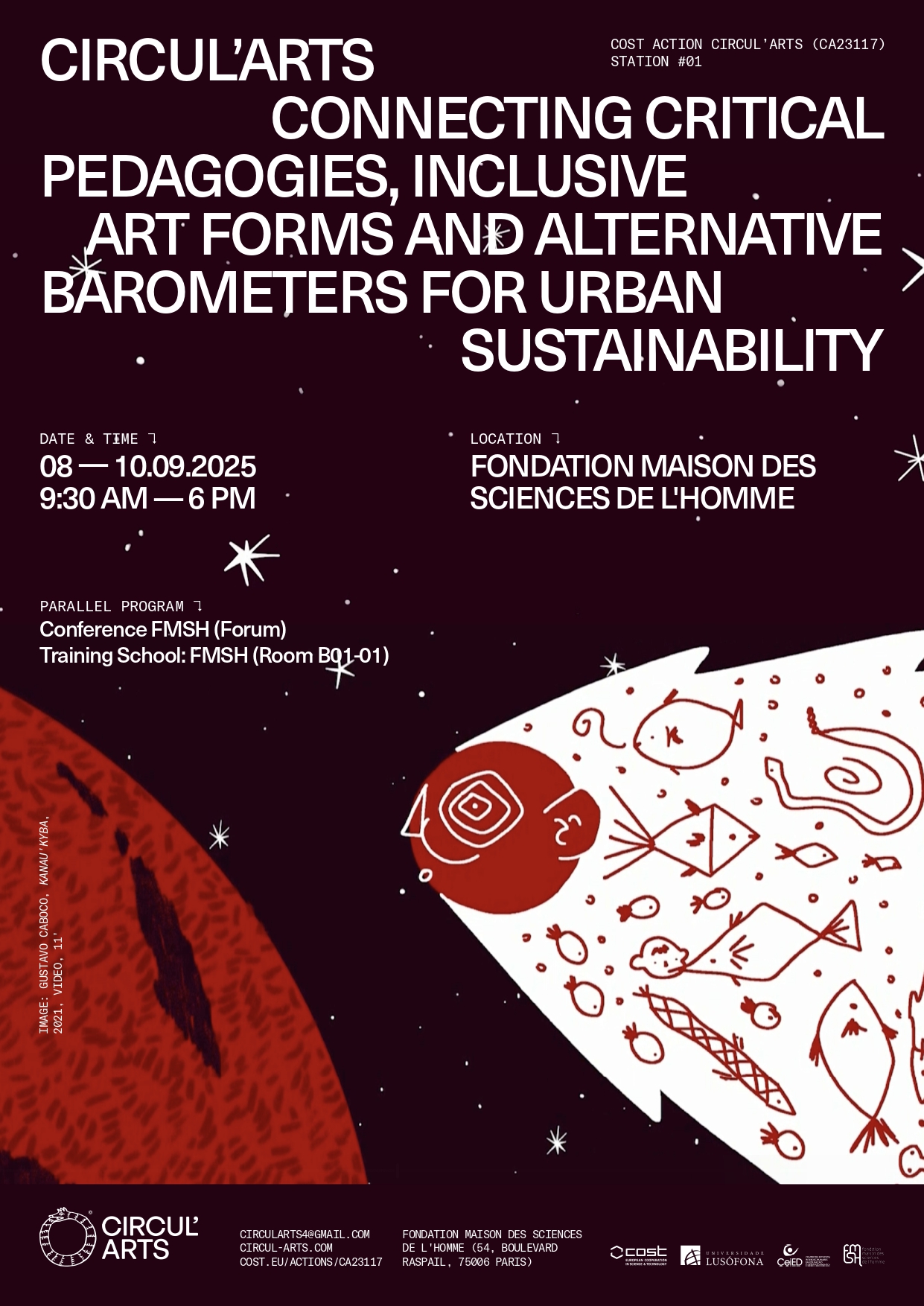
1st Station Final program
Presentations' Station#1 — WG 01 "Plural schooling and critical pedagogies"
Dr Carla Inguaggiato
Presentations' Station#1 — WG 02 "Plural schooling and critical pedagogies"
Slavica Janeshlieva,Medina Çeko, Hanna Musiol, Katarzyna Cytlak
Presentations' Station#1 — WG 03 "Urban Installations and Gathering Points"
Agata Pięt, Isabel Cristina Carvalho, Margarida Brito Alves, Kinga Kimic, Rita Ochoa, Stella Schroeder, Marta Padovan-Özdemir
Presentations' Station#1— WG 04 "Innovation through creative and circular technologies”
Gerald Leindecker
Presentations' Station#1 — WG 05 "Connecting Natures in the Urban Context"
Aurea Mota (leader) and Giovanbattista Tusa (co-leader)
Presentations' Station#1 — WG 06 "Dissemination and recommendations"
Dr Rahmin Bender-Salazar,
About Grant Output
Coming Soon
Paris station 2025, circularts network, audio report
Pantea Armanfar
Field notes from Paris
Patricia Morosan
CIRCUL-ARTs station 1 training school remixed, reimagined
Robert Eagle
About Artistic Manifestations
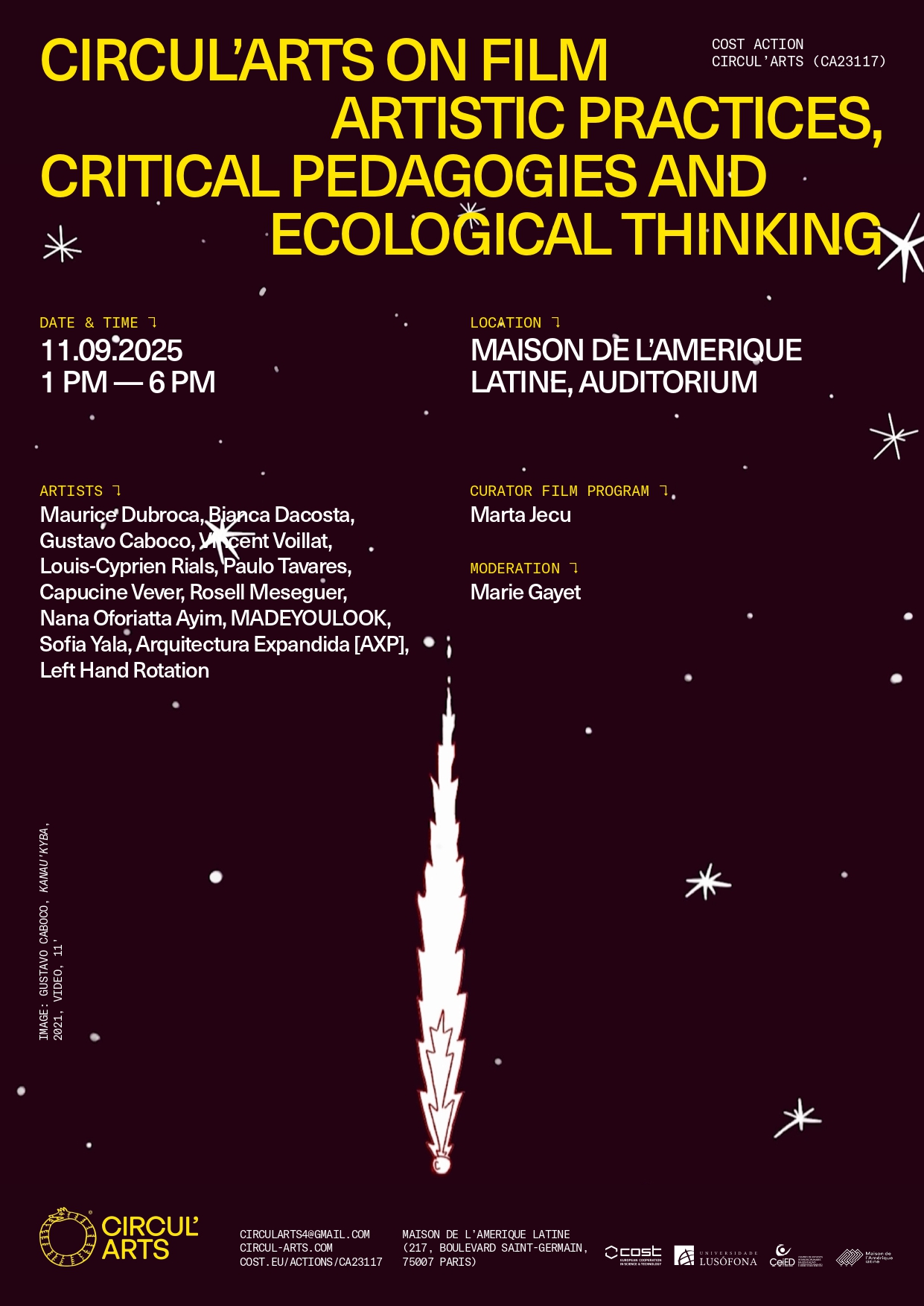
CIRCUL'ARTS Station#1 in Paris included a film screening program at Maison de l'Amerique Latine (11th September 2025), exploring the fusion between human and non-human natures in contemporary artistic production.
CIRCUL’ARTS AU CINÉMA
PRATIQUES ARTISTIQUES CIRCULAIRES, PÉDAGOGIES CRITIQUES
ET PENSÉE ÉCOLOGIQUE
X
CIRCUL’ARTS ON FILM
Artistic Practices..... h18
Programmation des films: Marta Jecu
Moderation: Marie Gayet
Maison de l'Amerique Latine, Auditorium, Paris
Presented films:
Maurice Dubroca (France): Frans Krajcberg, Portrait d’une Révolte , 8 min. (Presented by Eric Darmon, film producer).
Bianca Dacosta (Brazil) : Interior da Terra, 17 min. (ARTIST PRESENT)3.
Gustavo Caboco (Brazil), Kanau'kyba, 11 min.
Vincent Voillat (France), Le centre, c'est les pierres, vidéo sur smartphone, 8 min. HD. 2020 (ARTIST PRESENT)
Luis Cyprien Rials (France), Babel, 2023, 12 min
Paulo Tavares (Brazil), Non-human Rights, 4min
Capucine Vever (France), Ô Diryanké, 21min, Dérives Alpines, 19 min.
Rosell Meseguer (Spain), SLHS Tamarugal, Total: 26 min. (ARTIST PRESENT)
Nana Oforiatta Ayim (Ghana), Nowhere Else But Here, 24 min
MadeYouLook (Molemo Moiloa and Nare Mokgotho) (South Africa), Menagano, 5 min.
Sofia Yala (Angola), Constellation of Dust, Slideshow (5 min.)
Arquitetura Expandida (Colombia), La Comunidad dela Pala, 20 min. (ARTIST PRESENT)
Left Hand Rotation (Spain/Portugal), Sem manifestação (5 min), Bye, Bye and Thanks for nothing (5 min) , Tigre e Yaguarete, (27 min).
FILM SYNOPSES:
1. Maurice Dubroca (France) : Frans Krajcberg, Portrait d’une Révolte, 8 min. Production Mémoire Magnétique, (français). Présenté par Éric Darmon
Juif d'origine polonaise, "naturalisé" brésilien dans les années 50, Frans Krajcberg a connu un destin hors normes. Laminé par la seconde guerre mondiale, où sa famille périt, il "veut fuir les hommes " dans l'immédiat après-guerre. Au contact de la nature brésilienne, son œuvre est un cri
contre la destruction de la nature et de la vie. Aujourd'hui, son œuvre a acquis une dimension universelle et planétaire. De l'Amazonie à l'État de Bahia, en passant par le Minas Gerais, du Brésil à la France, nous suivons Krajcberg dans les lieux où il vit et où il travaille. Mais à travers le portrait
d'un homme, c'est avant tout l'histoire d'un destin et l'histoire d'une révolte que le film raconte.
Parmi les prix: Premier Grand Prix du Film d'art militant FIFAP - Maison de l'Unesco - Paris 2004, Prix du meilleur film francophone Festival du film de l'environnement FRAPNA - Grenoble 2005 LINK FILM EN ENTIER: http://www.memoiremagnetique.com/?page_id=370
*
A Jew of Polish descent, "naturalized" Brazilian in the 1950s, Frans Krajcberg had an extraordinary life. Crushed by the Second World War, in which his family perished, he "wanted to escape from humanity" in the immediate postwar period. In contact with Brazilian nature, his work is a cry
against the destruction of nature and life. Today, his work has acquired a universal and global dimension. From the Amazon to the state of Bahia, via Minas Gerais, from Brazil to France, we
follow Krajcberg in the places where he lives and works. But through the portrait of a man, it is above all the story of a destiny and the story of a revolt that the film tells. Among these awards: First Grand Prize for Militant Art Film FIFAP - Maison de l'Unesco - Paris 2004, Prize for Best French-Language Film FRAPNA Environmental Film Festival - Grenoble 2005
2. Bianca Dacosta (Brésil) : Interior da Terra, 17 min. (Brésilien sous-titré français) - Artiste présente La terre est une poussière magique qui a le pouvoir de conserver et de protéger les mémoires enfouies. Les couches qui se superposent dialoguent entre elles et racontent la transformation des
souvenirs de ce territoire en ressources. Couche après couche, extraire les richesses de la terre revient à effacer ses mémoires. Comme une exploration qui va du ciel jusqu’aux entrailles de la
forêt, le film est un voyage à travers les strates, pénétrant dans le sol pour révéler les couches d’histoire enfouie. Le film met en lumière la profondeur des enjeux politiques dans un récit à la
fois historique et actuel sur la destruction de la forêt amazonienne et de son peuple autochtone Mura.
*
The soil is a magical dust that has the power to store and preserve buried memories. The overlapping layers speak to each other and tell of the transformation of the memories of this
territory into resources. Layer upon layer, extracting the richness of the earth is erasing its memories.Like an exploration from the sky to the bowels of the forest, the film is a journey that
leads through the strata into the soil to reveal the layers of buried history. The film demonstrates the depths of political issues in a historical and current account of the destruction of the Amazon rainforest and its indigenous Mura people. (texte Bianca Dacosta).
3- Gustavo Caboco (Brésil), Kanau'Kyba, 2021, 11' – film d’animation, commande pour la 34ª
Biennale de São Paulo. Kanau'Kyba means "Roads of Stone" in the indigenous Wapichana language, of who's ancestry the artists is. The film has as a starting point a huge meteorite (bendegó) preserved in the National Museum of Rio de Janeiro and which represents an ancestor to the indigenous populations. When
the Museum suffered a fire in 2018 that devasted it almost completely, the meteorite was one of the items that survived. The animation shows stone landscapes in their multiple forms in the indigenuous belief system and territory: from the earthly stones in Serra da Lua, in Roraima, in the
Canauanim Indigenous Territory, to the stones in Paraná, Kurityba and back to the museum- the stone carries the memory of indigenuous culture that cannot be erased.
Kanau'Kyba signifie « Chemins de pierre » en langue indigène Wapichana, dont les artistes sont les
ancêtres. Le film s'inspire d'une immense météorite (bendegó), conservée au Musée national de
Rio de Janeiro et représentant un ancêtre des populations indigènes. Lorsque le musée a été presque entièrement ravagé par un incendie en 2018, la météorite a été l'un des objets ayant survécu. L'animation montre les paysages de pierre sous leurs multiples formes au sein des systèmes de croyances et des territoires indigènes : des pierres terrestres de la Serra da Lua, du Roraima, du territoire indigène de Canauanim, aux pierres du Paraná et de Kurityba, et enfin au musée, la pierre porte en elle la mémoire indélébile de la culture indigène.
4-Vincent Voillat (France), Le centre, c'est les pierres, vidéo sur smartphone, 8 min. HD (français sous-titre anglais)
Le centre, c’est les pierres se déploie comme une incantation nocturne. Un faisceau unique effleure des fragments — pierres et corps mêlés dans l’ombre — comme pour réveiller leur pulsation cachée. Le film s’ouvre et se referme sur une lune floue, un souffle entre apparition et disparition. Une voix parle d’épuisement, de désir et de fuite, puis se dissout peu à peu dans les pierres elles-mêmes, confessant leur souveraineté. Elles se dressent en amantes et en témoins, gardiennes des luttes oubliées, murmurant un langage plus ancien que la mémoire. La caméra
insiste jusqu’à ce que la vision chancelle, que les formes deviennent constellations. Ne demeure qu’une transe minérale, un passage où l’humain devient poreux,happé par le temps des pierres. Dans ce cycle hypnotique, le centre n’est plus nous, mais les pierres — silencieuses, immobiles, compagnes infinies de notre effacement. (Texte Vincent Voillat)
*
Le centre c’est les pierres unfolds like a nocturnal incantation. A single beam of light brushes over fragments—stones and bodies merging in the dark—as if awakening their hidden pulse. The film
opens and closes with a blurred moon, a breath between apparition and disappearance. A voice speaks of exhaustion, desire, and escape, yet gradually dissolves into the stones themselves, confessing their sovereignty. They stand as lovers and witnesses, guardians of forgotten struggles, murmuring a language older than memory. The camera lingers until vision falters, until forms turn to constellations. What remains is a trance of stone, a passage where the human becomes porous, swept into mineral time. In this hypnotic cycle, the centre is no longer us but the stones—silent,
immovable, and infinite companions of our vanishing.
5-Louis-Cyprien Rials (France), Babel, 2023, 12 min (artiste présent) Dans ce long plan-séquence sur un paysage de roches et de déserts, Louis-Cyprien Rials relie le mythe de Babel - la Tour de Babel, édifice construit tout en hauteur, perçu comme le moyen de
relier le ciel (le monde divin) à la terre et ses voix diverses, lieu de tolérance - au discours contemporain, où l'intelligence artificielle et le transhumanisme apparaissent comme de nouvelles tours de Babel. Accompagnée d'une bande-son composée par Romain Poirier, l'œuvre présente des extraits du Livre de la Genèse, traduits et lus par des programmes d'IA (DeepL et ElevenLabs).
Ce choix de narrateurs met en évidence les parallèles entre le mythe antique et les technologies modernes, où la quête de perfection de l'humanité à travers l'augmentation virtuelle et biologique
fait écho à l'ambition des constructeurs de Babel. Le film de Rials capture la tension entre transcendance et destruction, invitant les spectateurs à réfléchir au prix de l'orgueil dans un
monde où les outils pour construire de nouvelles Babels sont déjà à notre portée.
*
In this long sequence shot of a landscape of rocks and deserts, Louis-Cyprien Rials connects the myth of Babel—the Tower of Babel, a towering structure seen as a means of connecting heaven (the divine world) to earth and its diverse voices, a place of tolerance—to contemporary
discourse, where artificial intelligence and transhumanism appear as new Towers of Babel. Accompanied by a soundtrack composed by Romain Poirier, the work presents excerpts from the Book of Genesis, translated and read by AI programmes (DeepL and ElevenLabs). This choice of
narrators highlights the parallels between ancient myth and modern technologies, where humanity's quest for perfection through virtual and biological augmentation echoes the ambition of the builders of Babel. Rials' work captures the tension between transcendence and destruction,
inviting viewers to reflect on the price of pride in a world where the tools to build new Babels are already within our reach.
6- Paulo Tavares (Brésil), Non-human Rights, 4min et Trees, Vines, Palms, 2mn. (Espagnol et sous titres anglais)
Dans ces deux films NonHuman Rights (2012) et Trees, Vines, Palms and Other Architectural Monuments (2013), Paulo Tavares soulève d’un point de vue philosophique et d’un point de vue
historique la question du territoire et de la notion de nature ayant des droits au même titre que les êtres humains. NonHuman Rights s’appuie sur la pensée de Michel Serres et son livre Le
Contrat naturel (1990), dans lequel le philosophe propose de remplacer le contrat « social » par le contrat « naturel », ouvert à des formes de personnalités juridique non humaines. Le monde a droit au droit lui aussi. Dans Trees, Vines, Palms and Other Architectural Monuments, il nous
emmène sur les traces d’un village Xavante aujourd’hui disparu, où pourtant les espèces végétales
continuent de raconter une histoire, équivalant à des ruines architecturales, mais vivantes et non mortes. Peut-on considérer les arbres, les vignes et les palmiers comme des monuments
historiques ? La forêt est-elle un « patrimoine urbain » issu de formes d'aménagement non occidentales ?
*
In his two films NonHuman Rights (2012) and Trees, Vines, Palms and Other Architectural Monuments (2013), Paulo Tavares raises the question of territory and the notion of nature having rights on the same footing as human beings from a philosophical and historical perspective. NonHuman Rights draws on the thinking of Michel Serres and his book Le Contrat naturel (1990), in which the philosopher proposes replacing the ‘social’ contract with a ‘natural’ contract, open to
forms of non-human legal personality. The world also has rights. In Trees, Vines, Palms and Other Architectural Monuments, he takes us on a journey to a now-vanished Xavante village, where plant species continue to tell a story, equivalent to architectural ruins, but living and not dead. Can trees, vines and palms be considered historical monuments? Is the forest an ‘urban heritage’ resulting from non-Western forms of development?
7- Capucine Vever (France), Ô Diryanké, 21min, Dérives Alpines, 19 min (sous-titres français) Ô Diryanké est une ode à la mer, créée et interprétée par le chanteur et vieux pêcheur sénégalais
Thiarwa, de la baie de Dakar. Ô Diryanké (Oh la grande dame) est le surnom affectif que Thiarwa a pris l’habitude de donner à l’océan. L’océan, qui répond à Thiarwa, est le personnage central du film. Ses mouvements, ses ressacs, ses trafics, sa voix et sa mémoire nous accompagnent dans son
immensité. L'ode raconte l'histoire des navires migrants engloutis par la mer, mais rappelle aussi les chants des navires négriers qui naviguaient entre l'île de Gorée, autrefois l'une des plus
importantes citadelles esclavagistes. Le film montre la pollution de la mer et la manière dont la montée des eaux impacte cette île. L'histoire racontée par Thiarwa révèle la mer comme une
présence féminine à laquelle la population a établi une relation animiste intime.
*
Ô Diryanké is an ode to the sea, created and performed by the Senegalese singer and old fisherman Thiarwa, from the Bay of Dakar. Ô Diryanké (Oh the great lady) is the affectionate nickname that Thiarwa has taken to giving to the ocean. The ocean, which responds to Thiarwa, is
the central character of the film. Its movements, its undertows, its trafficking, its voice and its memory accompany us in its immensity. The ode tells the story of the migrant ships swallowed by the sea, but also recalls the songs of the slave ships that sailed between the island of Gorée, once
one of the most important slave citadels. The film shows the pollution of the sea and how the rising waters impact this island. The story told by Thiarwa reveals the sea as a feminine presence to which the population has established an intimate animist relationship.
Dérives Alpines captures the perspective of the mountains in a place once dominated by tourism.
The Alps, slowly melting due to global warming, are presented not as a solid, inert block, but through their own transformations, fragility and internal movements, revealed by innovative
cinematographic techniques.
About Program Lectures & Training Schools
CONNECTING CRITICAL PEDAGOGIES, INCLUSIVE ART FORMS AND ALTERNATIVE BAROMETERS FOR URBAN SUSTAINABILITY (CIRCUL’ARTS)
Cost Action: CA23117
STATION # 1
CIRCUL’ARTS is a COST ACTION gathering researchers and practitioners in a network that will focus, overall for 4 years (2024-2028), on enabling and empowering the public, thanks to the facilitation of art processes as modes of expression and exchange, to translate what they mean by ‘circularity and sustainability’ in urban settings. In this networking, we see these as a set of practices that involve not only the sharing of material resources, but more significantly, the transmission of immaterial knowledge and know-how—such as historical memory, vernacular solutions, practices of solidarity, and community-building. By investigating different ways to approach circularity and sustainability (with an accent on the Latin American and African contexts), participatory and genuine narratives emerge, that can induce a practical socio-ecological transition.
When? 8th -10th of September 2025 (Conference and Training School) and 11th of September 2025 (Core Group Meeting and Film Screening with Artists Meeting).
For how long? 4 days.
Where? Fondation Mais n des Sciences de l'Homme /FMSH (54, Boulevard Raspail, 75006 Paris) ; Maison de l'Amérique Latine (217, Boulevard Saint-Germain, 75007 Paris)
Detailed Program: 8th -10th September: Conference: FMSH (Forum)
8th -10th September: Training school: FMSH (Room B01-01)
11th September: 9.00-12.00. CORE GROUP MEETING Maison de l'Amérique Latine (Auditorium)
11th September: 13.00 - 18.00, FILM SCREENING WITH ARTISTS MEETING, Maison de l'Amérique Latine (Auditorium).
PROGRAM: CONFERENCE (Forum, FMSH) 8th September 2025
9.30 -10.00 : Welcome Coffee PROGRAM: CONFERENCE (Forum, FMSH)
10.00 -10.15 : Marta Jecu: Introduction Speeches and presentation of day's schedule.
10.15 – 10.40: WG1 Leaders Paolo Do and Carla Inguaggiato: Plural Schooling and Critical Pedagogies (including Q&A)
10.40 – 11.00: Maria Argyriou (University of the Aegean): Sensory Pedagogy and Alternative Forms
of Assessment: Learning Mappings through Art
11.00 – 11.20: Ana Paola Morel: Pluriversal Pedagogies: Weaving Belonging to the Earth
11.20 – 11.40: Analia Capponi: Singing as a practice of childhood – Towards an understanding of children’s political agency and voice in culturally diverse societies
11.40 – 11.50: Coffee Break
11.50 – 12.10: Muhammet Bas: Multidisciplinary Pedagogies for Inclusive Learning Environments
in Urban Margins
13.15 – 14.15 : Lunch break
14.15 – 15.00 : WG 5 Leaders Aurea Mota and Giovan Battista Tusa: Connecting 'natures' in the urban context (Including Q&A)
15.00 – 15.20 : Finat Cimsit Kos, ‘Responsive Ground: Transcalar Interventions in Urban Regeneration’
15.20 - 15.40 : Viktorija Mangaroska, ‘Urban Sustainability and Circular Arts: Reimagining Etno Selo as a Cultural-Ecological Educational Platform in Skopje North Macedonia’
15.40 - 15.50 : Coffee Break
15.50 – 16.10: Onur Birol, ‘Immersive Storytelling and Digital Reconstruction as Performative Pedagogy in Reclaiming Ancient Urban Ecologies’
16.10 - 16.30: Freyja van den Boom, ‘Paris 2030 Climate Futures’
16.30 – 16.50: Q&A for the case studies
16.50 – 17.30: Keynote Experts Communication : Prof. Dr. Carlos Alberto Torres, 'Global Citizenship Education, Sustainability policies, and eco-pedagogy: An agro-ecological experience in the Province of Buenos Aires, Argentina'.
9th September 2025
10.15 - 11.00: : WG 3 Leaders Agata Pięt and Isabel Carvalho: Urban installations and gathering
points. (Including Q&A)
11.00 – 11.15 : Rita Ochoa & Alessia Allegri: “Intermittent City: Developing Micro-Laboratories of Coexistence in the Age of Adaptation”
11.15 - 11.30 : Stella Schroeder: “Tactical Urbanism and Placemaking: Community-Led Urban Installation Methodologies”
11.30 - 11.45 : Kinga Kimic: “Greenery for CIRCUL’ARTs”
11.45 - 11.55 : Coffee Break
11.55 – 12.10 : Margarida Brito Alves: “On temporary uses and communities – T-FACTOR project in Trafaria”
12.10 - 12.30 : Q&A for the case studies
13.15 – 14.15 : Lunch break
14.15 – 15.00 : WG 2 Leaders Slavica Janeslieva, Katarzyna Cytlak, Hanna Musiol : Urban rituals, performances, street theatre, music. Slavica Janeslieva : "Skopje Urban Stories: site specific artistic practices".
15.00 – 15.20 : Medina Spahiu Çeko: "Revival of historical buildings through Art: The Case of Prizren"
15.20 - 15.40 : Hanna Musiol: “From art interventions to community rituals: Site-specific practices for cocreation, reciprocity, and durational care in environmental knowing”
15.40 - 15.50 : Coffee Break
15.50 – 16.10 : Katarzyna Cytlak: 'Dreaming of water:A ch’ixi practices by Ceclia Vucuña'
16.10 - 16.30 : Q&A for the case studies
16.30 – 17.00 : Report on Training School Day 1 and 2 (8th and 9th of September).
10th September 2025
10.15 - 11.00: : WG 4 Leader (Representative) Gerald Leindecker : Innovation through creative and circular technologies. 'Cirular Ecosystems on an Urban Scale ' . (Including Q&A)
11.00 – 11.20 : Renee Wansdronk: Emporium - Zero emission building concept - AR/VR/XR AI avatar tool
11.00 – 11.20; Aleksandra Stupar :‘Belgrade urban oases: Shaping the integrative nodes for environmental and social sustainability’ + Eleni Meletiadou: “Reclaimed Spaces: Empowering Migrant Women and Youth through Temporary Public Installations”.
11.20 - 11.40 : Songül Aral: "Integration of Sustainable Technical Basic Craft Knowledge: Weaving
and Knitting Applications and Prototypes."
11.40 - 11.50 : Coffee Break
11.50 – 12.10 : Q&A for the case-studies
12.10– 13.15 : Key Note Experts Communications and film screening: Odile Burluraux : 'Selection of artist’s videos from the Musée d’art moderne de Paris’s collection' (Part 1).
13.15 – 14.15 : Lunch break
14.15 – 15.00 : WG 6 Rahmin Bender-Salazar, Christian Roth, Breanne Pitt: Dissemination and Impact: Circular Economy, Arts, Educational Futures, & Systems Thinking.
15.00 – 15.20 : Roxana Dela Fiamor - Focus on Plan of Action for Communicating with the Public
15.20 - 15.40 : Eleni Meletiadou - Frameworks Co-Creation and Participatory Workshops as Dissemination (Pre-Recorded Video)
15.40 - 15.50 : Coffee Break
15.50 – 16.10 : Banu Yucel Toy - Training framework for dissemination workshops regarding
urban design and circular cities
16.10 - 16.30 : Q&A for the case studies
16.30 – 17.00 : Film screening Expert Odile Burluraux: 'Selection of artist’s videos from the Musée d’art moderne de Paris’ collection' (Part 2).
17.00 – 17.30: Report on Training School Day 3.
PROGRAM: TRAINING SCHOOL (FMSH, Room B01-01)
8th of September 2025. 10.00 – 16.30: Trainer Françoise Vergés (France, La Réunion)
9th of September 2025: 10.00 – 16.30: Trainer Carlos Alberto Torres (Argentina)
10th of September 2025: 10.00 – 16.30: Trainers Carina Maria Guimarães Moreira with Carlos
Henrique Aurélio dos Santos (Brazil)
PROGRAM MAISON DE L'AMERIQUE LATINE
11th of September - Auditorium
9.00 – 12.00. Core Group Meeting
13.00 – 18.00. Film screening & meeting with artists
About Program Artistic Manifestations
CIRCUL’ARTS ON FILM
Artistic Practices, Critical Pedagogies and Ecological Thinking Film Screening and Meetings with the artists
1. Maurice Dubroca (France): Frans Krajcberg, Portrait d’une Révolte , 8 min. (Presented by Eric Darmon, film producer).
2. Bianca Dacosta (Brazil) : Interior da Terra, 17 min. (ARTIST PRESENT).
3. Gustavo Caboco (Brazil), Kanau'kyba, 11 min.
4. Vincent Voillat (France), Le centre, c'est les pierres, vidéo sur smartphone, 8 min. HD. 2020
(ARTIST PRESENT)
5. Luis Cyprien Rials (France), Babel, 2023, 12 min
6. Paulo Tavares (Brazil), Non-human Rights, 4min
7. Capucine Vever (France), Ô Diryanké, 21min, Dérives Alpines, 19 min.
8. Rosell Meseguer (Spain), SLHS Tamarugal, Total: 26 min. (ARTIST PRESENT)
9. Nana Oforiatta Ayim (Ghana), Nowhere Else But Here, 24 min
10. MadeYouLook (Molemo Moiloa and Nare Mokgotho) (South Africa), Menagano, 5 min.
11. Sofia Yala (Angola), Constellation of Dust, Slideshow (5 min.)
12. Arquitetura Expandida (Colombia), La Comunidad dela Pala, 20 min. (ARTIST PRESENT)
13. Left Hand Rotation (Spain/Portugal), Sem manifestação (5 min), Bye, Bye and Thanks for
nothing (5 min) , Tigre e Yaguarete, (27 min).
CIRCUL’ARTS on FILM is a one-day film program presented within the framework of aninternational research project focused on contemporary artistic and creative contributions to
urban circularity and sustainability (www.circul-arts.com, 2024–2028). In this context, circularity is understood as a set of practices that involve not only the sharing of material resources, but more significantly, the transmission of immaterial knowledge and know-how—such as historical memory, vernacular solutions, practices of solidarity, and community-building. Particular attention is given to case studies originating from Latin America and the African continent.
The film program showcases artistic research by visual artists exploring sustainable urban interventions and forms of activism. This includes community empowerment strategies developed in Bogotá by Arquitectura Expandida, as well as international urban activism by Left Hand Rotation. Rosell Meseguer investigates resource extraction in Latin America, shifting the perspective from the human to the mineral realm itself. Gustavo Caboco, Maurice Dubroca, and
Bianca Dacosta are artists deeply engaged in the defence of Indigenous ecologies and belief systems in Brazil.
Other works adopt experimental and empathetic approaches (Vincent Voillat), or are embedded within multimedia research frameworks (Paulo Tavares), exploring the non-human world and the interdependencies that exist between species—within a long-term historical perspective that precedes human temporality (Capucine Vever, Luis Cyprien Rials). Films by the Ghanaian writer and curator Nana Oforiatta Ayim, the Angolan artist Sofia Yala, and the French artist Capucine
Vever address the transmission of ancestral knowledge and the affirmation of cultural identity
across diverse African cultures.
This film program is associated to a conference that takes place between thé 8th-10th of Septembre at Fondation Maison des Sciences de l'Homme (54, Boulevard Raspail, 75006 Paris).
ARTISTS BIOS